"Surely nobody does garden work in November?" It is a fair question, and the honest answer is: some jobs are fine all year, some need the right weather window, and a few are better left until spring. The difference matters, because the jobs that go wrong in winter tend to fail months later, not on the day.
The Short Version
- Fine in winter: timber and composite decking, fencing (if the ground is workable), pergolas, and design and planning work of every kind.
- Fine with the right conditions: paving, turfing, artificial grass, and anything involving concrete.
- Better in spring or summer: staining or oiling timber, sealing natural stone, and planting that needs to establish.
Concrete and Mortar: The Cold Is the Problem, Not the Rain
Anything that sets chemically, which means concrete for fence posts and bases and the mortar under paving, needs to stay above freezing while it gains strength. Industry guidance in the UK treats about 5°C as the baseline for pouring concrete, and wants the ground it goes onto to be unfrozen. Mortar suppliers give similar advice for paving, with their cut-offs sitting at roughly 2–5°C depending on the product and whether the temperature is rising or falling.
Concrete or mortar that freezes before it has set can look fine and still end up weak and crumbly. You will not see it on the day. You will see it the following summer, as a slab that rocks or a post that leans.
That does not mean paving stops from November to March. It means checking the overnight forecast, using the right mortar for the season, and covering fresh work in the evening. A cold, dry week in the low single digits is workable with care. A hard frost is not.
Paving and Porcelain
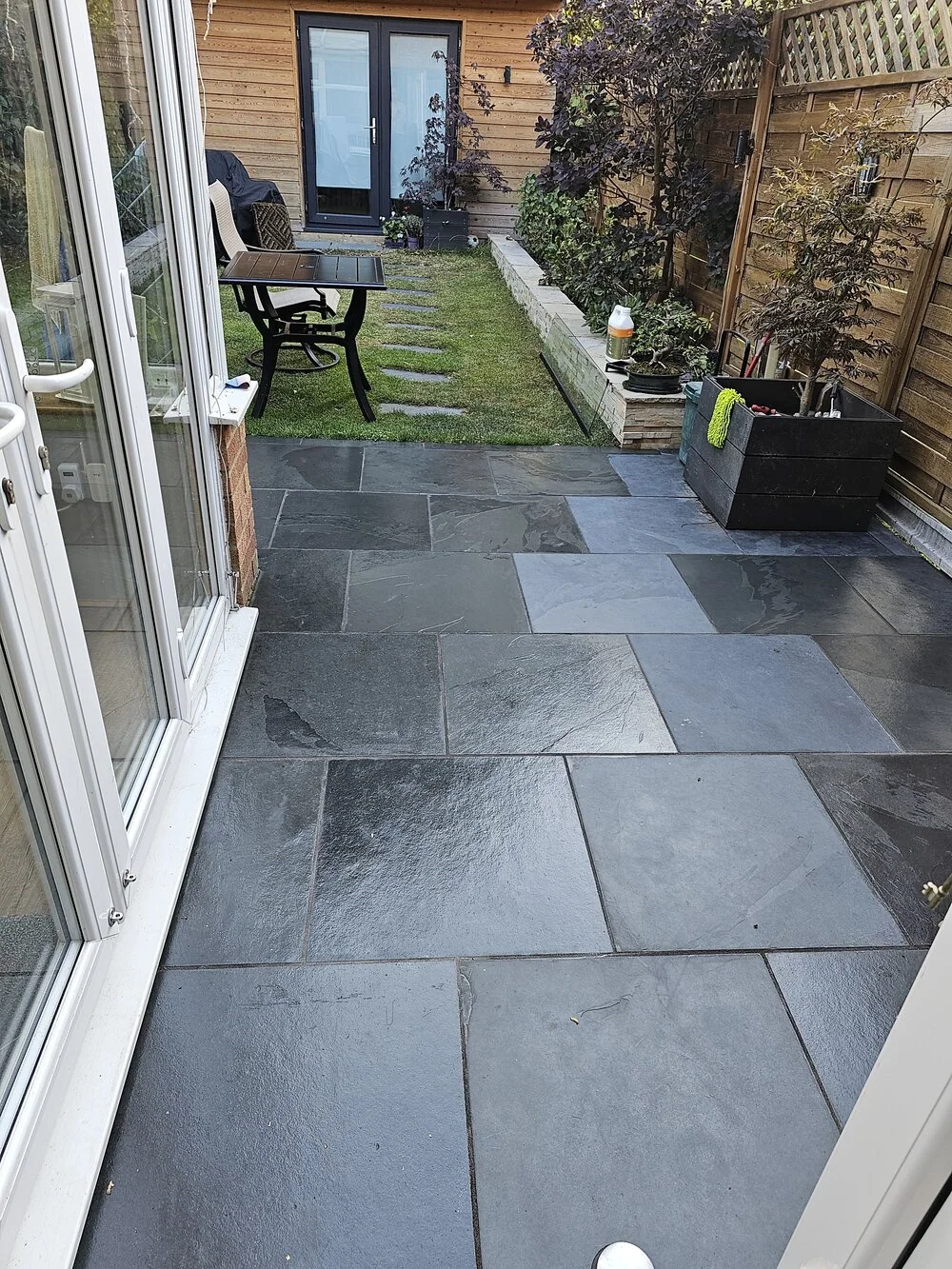
Laying onto frozen ground is a bad idea for a simple reason: when the ground thaws and settles, the slabs go with it. Wet weather is the other winter enemy, particularly for natural stone. Sealing sawn stone needs it to be properly dry, which is hard to guarantee in a wet December. If you are choosing between materials, our honest guide to paving stone and porcelain covers how each behaves once it is down.
Decking and Fencing
Decking is one of the more forgiving jobs in winter, because boards and joists do not care about the cold. What matters is the ground. If a frame is going onto soil, it needs to be workable, not frozen solid or waterlogged. The part that is better delayed is the finishing: oils and stains need dry boards and mild temperatures, and most tins state a minimum temperature, so a deck built in January is often best left to weather and oiled in spring. Our decking materials guide explains which materials need that treatment at all.
Fencing follows the same rule as decking, with one extra catch: fence posts are normally set in concrete, so the cold-weather points above apply. In a hard frost, setting posts is better postponed than rushed.
Turf and Artificial Grass
New turf will go down in winter, and in a mild spell it can settle in quietly because there is little mowing and little foot traffic to disturb it. The conditions to avoid are frozen ground and waterlogged ground. Roots cannot knit into frozen soil, and turf laid onto saturated soil compacts it and sits on poor drainage. Delivered rolls cannot wait indefinitely, so the schedule needs to follow the weather.
Artificial grass depends far less on the season, since there is no growing involved. The work is in the sub-base: it needs to be compacted properly, and you cannot do that well on frozen or sodden ground. Seam adhesive and tape also have minimum working temperatures, so it is worth checking the product instructions.
Not sure whether your job can go ahead now or should wait? Tell us what you are planning and we will say plainly whether winter is fine for it. You can also get a first price range in two minutes with our project estimator, covering fencing, patios, decking, pergolas, turfing and artificial grass.
Garden Rooms
The building itself is the least weather-sensitive part. What is sensitive is the groundwork: if the base involves concrete, the cold-weather rules above apply, and access across a wet, soft garden can be the bigger practical problem. Our regulations guide covers the planning and Building Control side, which does not change with the seasons.
Why Winter Is a Good Time to Plan
Even where the work itself should wait, the planning does not have to. Getting the design settled, the measurements taken and the price agreed over the winter means that when the weather turns, the job is ready to start rather than at the beginning of the queue. It also gives you time to think about the garden as a whole, rather than one project at a time.
If you would like a view on a specific project, get in touch for a free site visit, or send us photos on WhatsApp. We cover East and North London.